RANDPROOF Proof-of-Fair-Randomness (PoFR)
12-keeper threshold network live on Base Sepolia testnet — 4-of-12 BFT-safe signature committee, 11 entropy sources, 7 cryptographically signed.
Global Keeper Network
A decentralized, threshold-signed signature committee spanning six continents. Every node participates in the 4-of-12 BFT-safe fulfillment path.
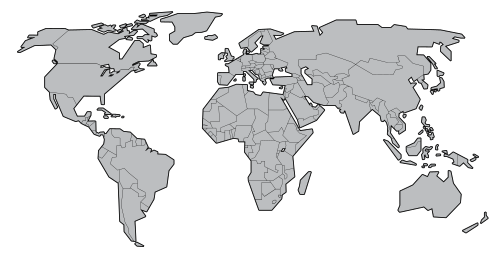
6 Regions · 6 Continents
Network at a glance.
11 Entropy Sources — 7 Cryptographically Signed
Signed sources are deterministic — all keepers derive the same values. V6 requires at least 3 of 7 signed sources to proceed. The committee fulfills with 4-of-12 signatures.


League of Entropy t=9-of-25 beacon
NIST Randomness Beacon (gap-anchored)
Block header Merkle root (self-hosted nodes)
Quicknet chain beacon
Block hash at deterministic target height
Mainnet block hash at anchored height
Block hash at anchored height
Australian National University Quantum RNG
Solana, SUI, TON, Cardano, Polkadot, Bittensor
block.timestamp + prevrandao
Base Sepolia block number at request time
Explore Live Proofs
Every randomness event produces a permanent on-chain RandProof artifact. Verify any proof independently — view entropy sources, signatures, seeds, and signer committee for every request.
Open RandProofScanOne keeper network. Every verification primitive.
Every product is Layer 1 infrastructure, usable by any contract, on any supported chain, with no relationship to the RandProof team required. No approval, a true Web3 decentralized infrastructure network. For all businesses and applications.
Fairness in selection has never been provable. Until now.
Every institution that selects, allocates, or assigns faces the same structural vulnerability: the party that runs the selection controls the outcome. Government grants, clinical trials, NFT mints, DAO governance, on-chain raffles: fairness is always asserted, never mathematically proven.
RandProof Network changes that. Every PoFR event produces a RandProof, a permanent, public, cryptographic proof that a specific selection was executed using decentralized randomness, verifiable by anyone, forever. Not a claim of fairness. A mathematical proof.
The network is operated by a permissionless, bonded, slashable keeper set across 17+ blockchains, with BIT5050, the Web3 50/50 raffle ecosystem, as the genesis client proving the protocol at production scale from day one.
- Mission
- Universal cryptographic fairness proof
- Protocol standard
- Proof-of-Fair-Randomness (PoFR)™
- Token
- None, just USDC or native assets
- Node operators
- Anyone who stakes earns 70% of fees
- Protocol revenue
- 20% fee from every PoFR event
- Clients
- Enterprises, governments, DeFi, DAOs, gaming
- Chains
- 17+ (EVM + non-EVM)
Proven By Math, Decentralized by Design
Verifiable fairness, decentralized trust, and universal access, explained without the jargon.
What is RANDPROOF
“Math That Proves It Was Fair”
RANDPROOF turns randomness into something anyone can verify.
“The Lie Detector for Randomness”
Every draw, shuffle, and selection comes with a tamper-proof receipt.
“Proof-of-Fair-Randomness, Built In”
Fairness isn't a promise, it's a cryptographic proof on-chain.
“Randomness You Can Audit”
No black boxes, no trusted oracles, just math anyone can check.
Trust & Transparency
“No Trusted Middleman. Just Math.”
Decentralized keepers sign every result; no admin key can change it.
“Tamper-Proof by Design”
15 independent entropy sources make manipulation economically impossible.
“A Permanent Receipt for Every Random Event”
Every PoFR event leaves an on-chain proof that never expires.
“Proven Fair. Forever.”
The proof lives on-chain, verifiable by anyone, at any time, years later.
Universal / Cross-Chain
“One Standard. Every Chain.”
Works across 17+ blockchains, EVM and non-EVM alike.
“Randomness Without Borders”
Ethereum, EVM, Solana, Cardano, TON, Sui, and more, all from one network.
“Any Industry. Any Chain. Any Selection.”
From jury duty to NFT drops, one protocol covers it all.
Cost & Access
“Fairness Without a Token Tax”
No competitor token required; pay per use in USDC or native gas.
“Randomness at 1/10th the Cost”
$0.05 to $0.25 per request vs. $0.25 to $2.00 with competitors.
“Permissionless by Default”
No KYC, no allowlist, no partnership required. Just integrate and go.
“Run a Node, Earn 70% of Fees”
Anyone can join the RANDPROOF Network. Keepers keep the lion's share of every network payment.
Real-World Use
“From Jury Selection to Jackpots”
The same protocol powers government lotteries and Web3 raffles.
“Fair Draws for Grants, Trials, and IPOs”
Public-sector integrity, backed by cryptographic proof.
“Randomness That Holds Up in Court”
Auditable proof artifacts designed for regulators and auditors.
Bigger Vision
“The Universal Standard for On-Chain Fairness”
RANDPROOF aims to be what HTTPS is for trust: a default.
“$100B to Cheat. $0.05 to Prove It.”
At full deployment, attacking the network costs more than most companies earn.
Verifiable by Anyone
Every PoFR event produces a RandProof a permanent on-chain proof artifact. Not a claim of fairness: a mathematical proof, verifiable by any third party at any time using only public on-chain data.
Chain-Agnostic
One standard across 17+ networks EVM chains, Solana, GRAM, Cardano, Sui, Polkadot, and more. No governance token required; clients pay per use in USDC/Native Network Cryptocurrency Tokens.
Permissionless Keepers
A bonded, slashable keeper network operates every product. Operators earn 70% of network fees run a node from a Mac mini, a desktop PC, or your phone. A true web3 decentralized network.
Phased rollout to full entropy deployment.
12-keeper threshold network live on Base Sepolia testnet — 4-of-12 BFT-safe signature committee, 11 entropy sources (7 cryptographically signed), 0 fulfillment errors.
- 17-chain BIT5050 genesis client
- Whitepaper June 2026
- PoFR™ terms coined
- 12 keepers · 4-of-12 threshold
- 11 entropy sources (7 signed)
- Base Sepolia (chainId 84532)
- 7/7 use-case tests passed
- External audit
- Permissionless staking
- Mobile app beta
- ~$1B attack cost
- Enterprise integrations
- RandProofCompute
- Full non-EVM
- ~$10B attack cost
- 1,000+ nodes
- All 15 entropy sources live
- $100B+ attack cost target
Full phased activation schedule in the whitepaper roadmap.
RandProof vs. Competitor VRF
Existing solutions require a third-party oracle token, are limited to EVM chains, or rely on single-source randomness. RandProof is the first chain-agnostic standard with multi-source entropy and a permanent proof artifact.
| Dimension | Competitor VRF | RandProof Network |
|---|---|---|
| Token required | Competitor token | None, just USDC / native assets |
| Entropy sources | 1 | 15 (Phase 4 target) |
| Public randomness beacons | 0 | 4 |
| Redundancy | None | 15 independent sources, 7 entropy domains |
| Admin key on fulfill() | Yes | No, the fulfillment path is immutable |
| Automation layer | Separate product (extra competitor token) | Built-in, same fee |
| Fee per request | $0.25–$2.00 in competitor token | $0.05–$0.25 in USDC / native |
| Chain support | ~15, EVM-focused | 17+, EVM + non-EVM |
Token required
Entropy sources
Public randomness beacons
Redundancy
Admin key on fulfill()
Automation layer
Fee per request
Chain support
Comparison per Whitepaper v0.57 (AV-148): Competitor figures as of June 2026 from public competitor documentation and pricing pages, subject to change. RandProof entropy-source and redundancy figures are Phase 4 targets per the roadmap; the live Phase 1 network on Base Sepolia currently aggregates 11 entropy sources (7 cryptographically signed).
Any industry. Any chain. Any selection.
Every organization below becomes a daily event emitter on the network, and every event funds keeper operators and grows decentralization.
View List Of Use CasesTested Integrations
All 7 use-case tests passed on Base Sepolia with 4-of-12 threshold and 7/7 signed entropy sources.
Multi-winner draws with provably fair selection
NFT minting with randomized traits and rarity
Cryptographic card shuffling with valid permutation proof
Fair sampling from candidate pools
Public randomness beacon for third-party verification
Adversarial test: evil client cannot disrupt fulfillment
24/7 Network Monitoring
Full monitoring stack tracking every keeper in real time.
Liveness and peer connectivity tracked per node.
Keeper down, RPC disconnected, fulfillment errors, peer divergence, non-EVM source down, keeper restarted, no fulfillments.
Real-time fulfillment latency monitoring across the committee.
Start building with provable fairness.
Integrate in four steps with no token purchase, or stake and run a keeper node to earn 70% of network fees.